.svg)
Introduction
Governance is indispensable in digital capability delivery, but it often fails in practice because it is implemented as a separate layer of meetings, approvals, templates, and reporting rather than as part of the work itself. This paper uses governance theatre as a practical label for a problem described in institutional theory as myth and ceremony and decoupling: formal structures can create legitimacy while remaining weakly connected to day-to-day practice or even to the outcomes they claim to improve (Meyer and Rowan, 1977; Bromley and Powell, 2012). In modern delivery environments, that decoupling appears when steering committees, risk registers, and stage gates sit outside requirements, design decisions, testing, release practice, and operational monitoring.
The stronger alternative is embedded governance: the integration of decision rights, controls, traceability validation, evidence, and monitoring directly into delivery artefacts and routines. This view is consistent with ISO / IEC 38500 and COBIT, which treat governance as evaluating, directing, and monitoring the use of technology, and with NIST, which frames governance as an operational foundation for risk management rather than a late-stage administrative overlay (ISO/IEC, 2024; ISACA, 2019; NIST, 2024). In agile, DevOps, and AI-enabled delivery, the most effective governance is therefore not approval-centred but evidence-centred: it asks what was decided, by whom, on what authority, with which controls, and how outcomes were validated.

Why Governance Becomes Theatre
Meyar and Rowan's classic argument was that formal organizational structures are often adopted because they signal rationality and legitimacy, not necessarily because they improve operational performance (Meyer and Rowan, 1977). Bromley and Powell later sharpened this insight by distinguishing policy-practice decoupling from means-ends decoupling: organizations may implement visible governance mechanisms while still failing to connect those mechanisms either to actual work practices or to real outcomes (Bromley and Power, 2012). Put plainly, governance can look impressive and still be inert.
This is exactly what many organizations experience in digital delivery. Governance becomes a reporting layer rather than a decision system; approval forums occur after practical decisions have already been made; "required" documentation is produced for compliance optics rather than operational use; and risk registers are maintained separately from the requirements, controls, tests, and releases where risk is actually created or reduced. That pattern is the opposite of what the IT governance literature recommends. MIT CISR defines governance as the specification of decision rights and accountability frameworks, and its long-running research argues that effective governance must be actively designed, not assembled from isolated mechanisms introduced at different times for different problems (Weill and Ross, 2004).
Authoritative governance frameworks also point away from theatre and toward integration. ISO/IEC 38500 states that governing bodies should evaluate, direct, and monitor the use of IT; COBIT places governance objectives in the same evaluate-direct-monitor pattern; and NIST CSF 2.0 makes the GOVERN function the mechanism through which risk strategy, expectations, and policy are established, communicated, and monitored across delivery activities (ISO/IEC, 2025; ISACA, 2019; NIST, 2024). Governance, in other words, is not a decorative wrapper around delivery. It is the discipline by which delivery is made accountable.
What Embedded Governance Looks Like
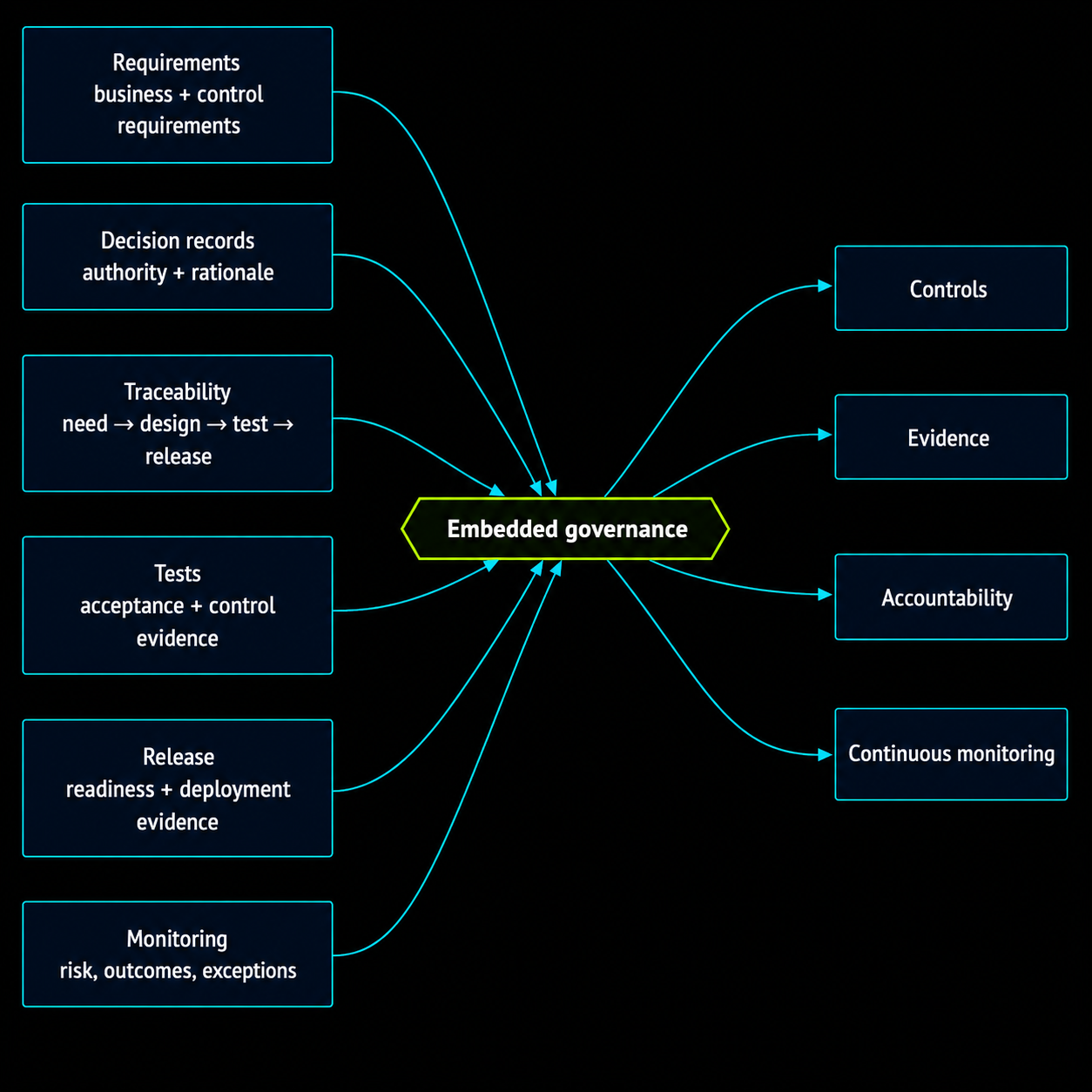
A practical definition follows from those sources: embedded governance is the integration of governance principles, decision accountability, controls, traceability, validation, and assurance directly into the artefacts and practices of delivery. It is visible not only in committee papers but in business requirements, non-functional requirements, architectural decisions, control statements, data definitions, privacy and security requirements, acceptance criteria, test cases, release readiness criteria, and post-release monitoring. This is closely aligned with IIBA guidance, which defines requirements life cycle management as ensuring that business stakeholder, and solution requirements and designs remain aligned, and with its explicit view that traceability supports conformity, change control, scope, risk, cost, and communication management (IIBA, n.d.).
Embedded governance also requires bidirectional traceability. NASA defines traceability as a discernible association between requirements, system elements, verifications, or tasks, and bidirectional traceability as the ability to move both up to parent expectations and down to allocated child requirements and verifications (NASA, 2023). NIST's Secure Software Development Framework similarly argues that secure development practices must be integrated into each SDLC implementation, which the NIST Risk Management Framework places security, privacy, and supply chain risk management inside the system development lifecycle itself (NIST, 2022; NIST, 2018). Governance is therefore strongest when it is woven into the lifecycle rather than appended to it.
Practical Examples
A privacy committee can approve a policy, but that is not yet embedded governance. In a privacy-sensitive digital service, embedded governance means that privacy obligations appear in the requirements themselves: lawful basis, consent capture, withdrawal flows, minimization defaults, retention rules, access controls, and evidence of compliance. The GDPR requires organizations to be able to demonstrate consent and to make withdrawal as easy as giving consent, while the ICO's guidance states that data protection by design must be considered at the start of the work and throughout the lifecycle. with mapping of personal data, risks, and technical and organizational measures, and with impact assessments where risk is high (European Union 2016; ICO, 2026). A governance forum that approves the service but does not ensure those elements are built into requirements, user journeys, configurations, tests, and monitoring is performing theatre, not governance.
The same logic applies to AI-assisted decisioning. An enterprise AI policy is necessary, but it is not sufficient. Embedded governance requires approved data sources, explicit decision thresholds, documented assumptions, human review points, explainability expectations, privacy controls, validation criteria, model or agent monitoring, and audit trails. NIST's AI RMF defines trustworthy AI in terms that are directly operational, valid and reliable, safe, secure and resilient, accountable and transparent, explainable and interpretable, privacy-enhanced, and fair with harmful bias managed. OECD's AI Principles seek innovative and trustworthy AI that respects human rights and democratize values, while ISO/IEC 42001 and ISO/IEC 42005 add structured management-system and impact-assessment disciplines for AI across the lifecycle (NIST, 2023; OECD, 2024; ISO/IEC, 2023; ISO/IEC,2025). If those elements are absent from requirements, test evidence, release conditions, and monitoring, AI governance remains abstract.
A financial system implementation makes the same point from a controls perspective. Board packs and project dashboards may demonstrate attention, but embedded governance requires control activities in the implementation process itself: approvals, reconciliations, authorization rules, reporting integrity, monitoring, and independence of critical duties. COSO's internal-control and ERM guidance emphasizes internal control, monitoring, risk management, and the connection between objectives, strategy, risk, and day-to-day practice. Deloitte's COSO-based summary is explicit that control activities include authorizations, approvals, verifications, reconciliations, and reviews, and that segregation of duties (SOD) is typically built into those activities (COSO, n.d.; Deloitte, 2020). In release management, DORA's research is equally clear: high-performing organizations do not rely primarily on external change advisory boards; they embed governance through peer review, automated testing, continuous integration, deployment automation, monitoring, and fast feedback. NIST SSDF and continuous-monitoring guidance reinforce that controls and evidence should be integrated into the lifecycle and release process rather than reconstructed afterward (DORA, 2014; DORA, 2025; NIST, 2022; NIST, 2011).
From Oversight to Evidence in Agile, DevOps, and AI Delivery
The strategic implication is that governance should be treated as a delivery design problem, not merely a project-oversight problem. Weill and Ross argue that effective governance is fundamentally about decision rights and accountability; ISO 31000 frames risk management as identifying, analyzing, evaluating, treating, monitoring, and communicating risk; and NIST RMF integrates those concerns into the system development lifecycle (Weill and Ross, 2024; ISO, 2018; NIST, 2018). This means that governance should be designed into the operating model: who decides, what evidence is required, how requirements map to controls, how acceptance is demonstrated, how releases are gated, and how outcomes are monitored in production.
That is why the shift from approval-centred to evidence-centred governance is so important. In agile and DevOps settings, late external approvals often slow delivery without improving control, while peer review, automated tests, version control, and observability improve both speed and safety. DORA's research on change approvals and continuous delivery supports this point, and IIBA's guidance on traceability supports the complementary business-analysis point: if requirements, designs, test, and releases are linked, governance evidence is generated as part of normal delivery rather than retrofitted after the fact (DORA, 2014; DORA, 2025; IIBA, n.d.). Evidence-centred governance therefore asks not merely who approved, but what decision was taken, on what evidence, under what authority, with which controls, and how the outcome was validated.
AI-enabled delivery intensifies this requirement. AI can accelerate analysis, code generation, testing, documentation, and design exploration, but acceleration without structured intent can amplify error, ambiguity, and hidden risk. NIST's AI RMF, ISO/IEC 42001, and OECD's AI Principles all point in the same direction: trustworthy AI depends on governance, documentation, accountability, transparency, and monitoring. In practical terms, that means organizations need approved source context, explicit requirements, logged assumptions, human-in-the-loop review, test evidence, versioned prompts or model configurations where relevant, exception handling, and post-release monitoring for drift and unintended effects (NIST, 2023; OECD, 2024). AI does not eliminate governance work; it redistributes it earlier and makes traceability more valuable.
A Short Implementation Checklist
A practical starting point is to embed a small number of non-negotiable disciplines into the delivery system itself;
1. Define control-bearing requirements alongside functional requirements, including privacy, security, retention, approval, and auditability expectations (IIBA, n.d.; ICO, 2026).
2. Maintain decision records for materially important business and technical choices, including authority, rationale, alternatives, and downstream impacts (Weill and Ross, 2004).
3. Build live traceability from business need to design, test, release, and operational monitoring so that changes trigger visible impact analysis (IIBA, n.d.; NASA, 2023).
4. Treat tests as governance evidence, not only quality checks: acceptance tests, control tests, data migration checks, and release-readiness criteria should all produce reusable assurance evidence (DORA, 2025; NIST, 2022).
5. For AI-enabled delivery, require approval source context, human review, validation criteria, and monitoring before release to production (NIST, 2023; ISO/IEC, 2023; OECD, 2024).
Why this Improves Quality, Trust, and Speed
Embedded governance improves quality because defects, omissions, and control gaps are detected earlier, when they are cheaper to fix. It improves trust because stakeholders, auditors, regulators, and operational teams can see traceable evidence rather than relying on verbal assurances. And it can improve speed because automated tests, peer review, version control, and continuous delivery replace slow manual approval rituals with faster, more reliable control points. That combination, better decisions, clearer accountability, earlier risk visibility, and stronger operational evidence, is precisely what authoritative governance, risk, and delivery research recommends (Weill and Ross, 2024; DORA, 2014; DORA, 2025; ICO, 2026).
Conclusion
Organizations should not abandon governance; they should mature it. Governance fails when it becomes a separate theatre of meetings, approvals, reporting, and documentation that is disconnected from how work is actually defined, implemented, tested, release, and monitored. Governance succeeds when it is embedded in the artefacts and routines of delivery itself: requirements that carry controls, decisions that preserve rationale and authority, traceability that links need to evidence, tests that prove both behavior and compliance, releases that produce operational assurance, and monitoring that closes the loop. The future of governance is not more governance theatre, it is embedded governance. Practical, traceable, evidence-based control built directly into delivery.
How Requirementum QGR Supports Embedded Governance
Requirementum QGR supports this conclusion by helping organizations turn governance from an external oversight ritual into a structured delivery discipline. Its contribution sits in the practical middle of transformation work: business analysis, business architecture, requirements strategy, process modelling, decision documentation, governance traceability, risk and control alignment, acceptance criteria, testing and validation planning, release readiness, and implementation-ready documentation. Through Intentium, its AI-enabled delivery approach, business intent, requirements, decisions, risks, controls, acceptance criteria, and validation evidence can be structured so that both human teams and AI tools remain aligned to accountable business outcomes. In that sense, Requirementum QGR is not an argument for "more governance"' it is an argument for governance that is usable, evidenced, and built into the work.
REFERENCES
Bromley, P. and Powell, W.W. (2012) ‘From Smoke and Mirrors to Walking the Talk: Decoupling in the Contemporary World’, Academy of Management Annals, 6(1), pp. 483–530.
Committee of Sponsoring Organizations of the Treadway Commission (COSO) (n.d.) Internal Control. COSO.
Committee of Sponsoring Organizations of the Treadway Commission (COSO) (n.d.) Enterprise Risk Management. COSO.
Deloitte (2020) COSO – Control Activities. Deloitte.DORA (2014) State of DevOps Report. DevOps Research and Assessment.
DORA (2025) Streamlining Change Approval. DevOps Research and Assessment.
European Union (2016) Regulation (EU) 2016/679 of the European Parliament and of the Council. Brussels: European Union.
Information Commissioner’s Office (ICO) (2026) Data Protection by Design and by Default. Wilmslow: ICO.
International Institute of Business Analysis (IIBA) (n.d.) Requirements Life Cycle Management. Toronto: IIBA.
International Institute of Business Analysis (IIBA) (n.d.) Trace Requirements. Toronto: IIBA.
International Institute of Business Analysis (IIBA) (n.d.) Understanding Requirements and Designs. Toronto: IIBA.
ISACA (2019) COBIT 2019 Framework: Governance and Management Objectives. Schaumburg, IL: ISACA.
ISO (2018) ISO 31000: Risk Management — Guidelines. Geneva: International Organization for Standardization.
ISO/IEC (2023) ISO/IEC 42001: Information Technology — Artificial Intelligence — Management System. Geneva: International Organization for Standardization and International Electrotechnical Commission.
ISO/IEC (2024) ISO/IEC 38500: Information Technology — Governance of Organizations. Geneva: International Organization for Standardization and International Electrotechnical Commission.
ISO/IEC (2025) ISO/IEC 42005: Artificial Intelligence — AI System Impact Assessment. Geneva: International Organization for Standardization and International Electrotechnical Commission.
Meyer, J.W. and Rowan, B. (1977) ‘Institutionalized Organizations: Formal Structure as Myth and Ceremony’, American Journal of Sociology, 83(2), pp. 340–363.
National Aeronautics and Space Administration (NASA) (2023) Requirements Management. Washington, DC: NASA.
National Institute of Standards and Technology (NIST) (2011) Information Security Continuous Monitoring for Federal Information Systems and Organizations. Gaithersburg, MD: NIST.
National Institute of Standards and Technology (NIST) (2018) SP 800-37 Rev. 2: Risk Management Framework for Information Systems and Organizations. Gaithersburg, MD: NIST.
National Institute of Standards and Technology (NIST) (2022) SP 800-218: Secure Software Development Framework Version 1.1. Gaithersburg, MD: NIST.
National Institute of Standards and Technology (NIST) (2023) Artificial Intelligence Risk Management Framework 1.0. Gaithersburg, MD: NIST.
National Institute of Standards and Technology (NIST) (2024) Cybersecurity Framework 2.0. Gaithersburg, MD: NIST.OECD (2024) Recommendation of the Council on Artificial Intelligence. Paris: OECD.
Weill, P. and Ross, J.W. (2004) IT Governance: How Top Performers Manage IT Decision Rights for Superior Results. Boston, MA: Harvard Business School Press.
.png)