.svg)
Strategy is not corporate slogan, a list of aspirations, or a budget target. In the classic literature, strategy is a disciplined set of choices about where to compete, how to create advantage, and what coherent actions will follow. Michael Porter distinguishes strategy from operational effectiveness and describes it as choosing a unique and valuable position supported by a system of reinforcing activities; Henry Mintzberg argues that strategy is not only intention but also a realized pattern in action; and Richard Rumelt argues that good strategy requires a diagnosis, a guiding policy, and coherent action (Porter, 1996; Mintzberg, 1987; Rumelt, 2011). Strategy, therefore, is real precisely because it changes what an organization does.

This paper argues that speed is now part of strategy itself. A strategy may be conceptually sound and still lose value if it is translated too slowly into initiatives, requirements, systems, and operational change. In turbulent markets, delay erodes strategic value because assumptions decay, priorities shift, competitors move, and customer expectations change. Research from the Agile tradition and DORA's software delivery program shows that shorter feedback cycles, small batches, user focus, and visibility from idea to customer outcome improve learning and performance; unstable priorities and slow translation reduce productivity and increase risk (Beck et al., 2001; DORA, 2021; DORA, 2024; DORA, 2025).
AI changes the economics of execution. Official research from Microsoft reports substantial productivity gains in some software-development settings, while METR shows that AI can also slow experienced developers in other contexts. DORA's recent work therefore describes AI as an amplifier: it magnifies both strengths and dysfunctions. The practical conclusion is not "faster coding"; it is that strategy must become more structured, testable, and machine-actionable if organizations want AI to accelerate the right work rather than the wrong work (Microsoft Research, 2023; Microsoft Research, 2025; METR, 2025; DORA, 2025).
Strategy as a real discipline
The strongest strategy thinkers treat strategy as choice under constraint, not as rhetoric. Porter's central distinction is between operational effectiveness and strategy: effective operations matter, but they are not enough, because rivals can imitate best practices; the essence of strategy is choosing a unique and valuable position and maintaining fit across activities (Porter, 1996). Mintzberg broadens the definition by showing that strategy is both intended and realized: organizations may articulate plans, but strategy only becomes real when it appears as a pattern in actual behavior (Mintzberg, 1987). Rumelt sharpens the analytic core by arguing that good strategy contains three elements, a diagnosis of the challenge, a guiding policy, and coherent action, and that bad strategy often mistakes ambition, vision, or financial targets for strategy itself (Rumelt, 2011).
Taken together, these thinkers establish three points that matter in the AI era. First, strategy is selective: it defines what matters and what does not. Second, strategy is causal: it links actions to a diagnosis of the problem. Third, strategy is operational: if choices do not shape conduct, they are not yet strategy in any meaningful sense. That is why strategy cannot be dismissed as a buzzy word. Properly understood, it is the architecture of coordinated action under uncertainty (Porter, 1996; Mintzberg, 1987; Rumelt, 2011).
Why speed is part of strategy
If strategy is realized in action, then the latency between decision and execution matters. Slow execution is not a merely operational defect; it changes strategic value. Mintzberg's distinction between intended and realized strategy implies that the longer an organization takes to act, the greater the chance that its realized strategy will diverge from its stated intent because conditions, incentives, or behavior will have shifted in the meantime (Mintzberg, 1987). Rumelt's more recently writing emphasizes timely feedback as essential to learning what works and what does not. Strategy, in other words, gains force through fast learning loops, not through static declaration alone (Rumelt, 2024).
Modern delivery research reinforces this point. The Agile Manifesto's principles call for early and continuous delivery, welcome changing requirements, and prefer shorter timescales because competitive advantage depends on learning and responding before the window closes (Beck et al., 2001). DORA reaches the same conclusion empirically from software-delivery research: visibility of work from business to customer outcome, user-centric focus, customer feedback, and working in small batches all support higher software-delivery and organizational performance because they shorten the time between hypothesis and evidence (DORA, 2023; DORA, 2025). DORA's 2024 report also finds that unstable priorities meaningfully reduce productivity and increase burnout, suggesting that delayed or constantly retranslated strategy imposes real organizational cost (DORA, 2024).
The implication is an important inference: strategic value decays with delay. If a strategy is implemented too slowly, it may still be "good" in abstract logic yet less valuable in practice because the market, customer, regulatory context, or technical stack has moved on. Speed therefore becomes part of strategic quality itself, especially where digital capabilities are the means of execution.
Why traditional pipelines are now too slow
Many organizations still translate strategy through long sequential chains: strategy decks become portfolios, portfolios become initiatives, initiatives become projects, projects become requirements, requirements become tickets, and only then do design, build, test, and deployment begin. Each step adds interpretation, handoffs, waiting time, documentation drift, and governance delay. This model can create the appearance of control while increasing the time between strategic intent and operational evidence. The Agile Manifesto explicitly arose against this kind of rigidity, arguing for a balance that values documentation and planning but recognizes the limits of both in a turbulent environment (Beck et al., 2001).
DORA's capability model explains why this matters. High performance depends on understanding the flow of work from business through to customers, not merely the status of internal tasks. DORA also shows that high-quality internal documentation is foundational and that documentation amplifies the benefits of technical capabilities; documentation is valuable when it preserves intent and supports execution, not when it becomes a separate reporting layer (DORA, 2021; DORA, 2023; DORA, 2026). Put differently, the problem is not documentation per se. The problem is translation loss, the repeated conversion of strategic meaning into disconnected artefacts that are no longer close enough to execution to guide it effectively.
Attribute
Traditional strategy execution
Speed-optimized strategy execution
Primary artefact
Slide deck, programme, project plan
Structured intent, capability definition, executable specification
Translation path
Many handoffs across functions
Fewer interpretive layers; closer coupling to delivery
Feedback cadence
Late, milestone-based
Continuous, small-batch, evidence-driven
Change handling
Formal re-planning and backlog churn
Built-in adaptation through short cycles and testable intent
Governance style
Separate approvals after handoff
Embedded controls, traceability, and release decks
AI readiness
Weak when context is fragmented
Stronger when context is structured and machine-actionable
How AI compresses strategy and execution:
AI compresses stages of the delivery chain. Official research from Microsoft Research found that developers using GitHub Copilot completed a controlled coding task 55.8% faster, and later randomized field experiments across Microsoft, Accenture, and a Fortune 100 company found a 26.08% increase in completed tasks for developers given access to an AI coding assistant (Microsoft Research, 2023; Microsoft Research, 2025).
However, AI acceleration is neither uniform nor automatic. METR's randomized trial of experienced open-source developers working in familiar repositories found the opposite result: allowing AI tools increase completion time by 19% (METR, 2025). DORA's interpretation is therefore the most useful one for strategy: AI acts as an amplifier. Without a user-centric compass, high-quality documentation, and accessible internal data, AI can accelerate activity while worsening direction, stability, or rework (DORA, 2025; DORA, 2026).
This is where AI changes strategy itself. If tools can help generate designs, code, tests, deployment scripts, and documentation, the bottleneck shifts upstream toward intent quality. GitHub's Spec Kit and spec-driven development guidance make this explicitly: specifications become executable and serve as the source of truth for tools and AI agents to generate, test, and validate code. Coding is no longer the first serious act of execution; the specification becomes the operational contract (GitHub, 2025).
An intent-centric model for executable strategy
The emerging alternative is executable strategy: strategy is expressed not only as a narrative but as a structured set of artefacts that can directly guide digital capability delivery. In this model, the organization defines a bounded chain of intent: strategic objective, diagnosis, capability definition, constraints, non-functional requirements, decision rules, acceptance tests, and operational measures. These artefacts are sufficiently precise for machines to act on and sufficiently governed for humans to review. GitHub's description of spec-driven development closely matches this model: Intent first, guardrails explicitly, refinement multi-step, and AI used to interpret and implement specification rather than improvise from thin prompts (GitHub, 2025).
DORA's research implies the same requirements from another direction. Reliable AI context depends on accessible and accurate internal data; high-quality documentation improves performance; user-centricity predicts better outcomes; and visibility from idea to customer matters because organizations need to see whether strategic hypotheses are producing value (DORA, 2021; DORA, 2023; DORA, 2025; DORA, 2026). The point is not "less thinking" or "no documentation", it is the right documentation must be live, structured, and close to execution.
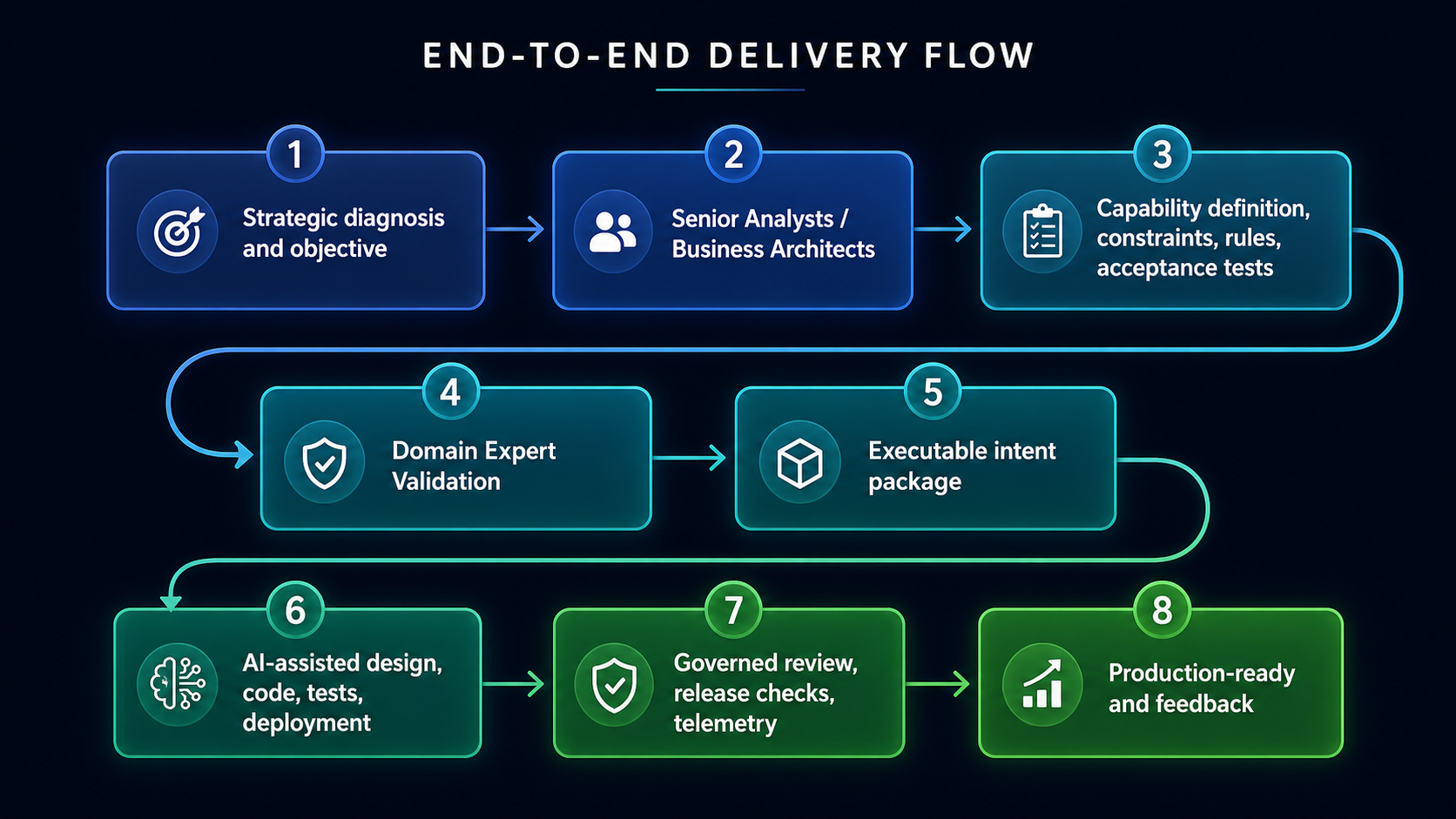
Requirementum QGR and the reduction of distance to capability:
The preceding analysis points to a practical conclusion: strategy must be translated into production-ready capability with less delay, less interpretation loss, and greater operational precision. Requirementum QGR applies this conclusion by focusing on the reduction of distance between business intent and production ready digital capability. In this model, the strategic challenge is not only to decide well, but to ensure that strategic intent remains clear, structured, validated, and executable as it moves toward implementation.
Requirementum QGR's approach begins with Senior Analysts and Business Architects working close to the strategic problem. Rather than decomposing strategy immediately into generic projects, tickets, or delivery tasks, they begin by clarifying the strategic diagnosis, identifying the required business capability, and structuring the artefacts needed for direct execution. These artefacts may include capability maps, objective statements, boundary conditions, business rules, exception scenarios, non-functional requirements, acceptance criteria, traceability links, and release controls. Domain experts then validate whether this intent reflects operational reality, including edge cases, regulatory constraints, market conditions, process exceptions, and the practical meaning of success. Only after this translation and validation are complete are AI-enabled tools used to expand the artefacts into solution design, test suites, implementation scaffolds, deployment workflows, and supporting documentation. This aligns with GitHub's spec-driven approach, DORA's emphasis on reliable internal context, and NIST's requirement for governance in technology delivery (GitHub, 2025; DORA, 2021; DORA, 2026; NIST, 2023; NIST, 2024).
Practically, the value of the Requirementum QGR model lies in four reductions. It reduces semantic distance by preserving strategic meaning in a structured, testable form instead of allowing it to dissipate across handoffs. It reduces temporal distance by placing AI-enabled design, build, and test tools closer to validated intent, thereby shortening design-build-test cycles. It reduces organizational distance by pairing analysts with domain experts rather than relying on downstream rediscovery of business reality. It also reduces governance distance by embedding controls, tests, traceability, and release criteria directly into the artefacts that drive execution. The result is not speed for its own sake; it is strategy executed at the speed at which value can still be captured.
This does not imply that AI-enabled acceleration removes the need for judgement. Microsoft's and METR's findings show that productivity gains are context-dependent, while DORA and NIST both emphasize that poor context, unstable priorities, weak documentation, and insufficient governance can degrade outcomes (Microsoft Research, 2025; METR, 2025; DORA, 2025; NIST, 2023; NIST, 2024). For that reason, Requirementum QGR treats AI as an extension multiplier under expert guidance, not an autonomous substitute for strategy, architecture, analysis, or validation. Its model is therefore positioned around a central principle of AI-era strategy: the faster execution becomes, the more important it is to ensure that what is executed remains close to business intent.
REFERENCES
Beck, K. et al. (2001) Manifesto for Agile Software Development and Principles behind the Agile Manifesto.
DORA (2021) Accelerate State of DevOps Report 2021.
DORA (2023) Research programme summaries on user-centricity and documentation quality.
DORA (2024) Accelerate State of DevOps Report 2024.
DORA (2025–2026) Capability pages on value-stream visibility, small batches, user-centricity, and AI-accessible internal data.
GitHub (2025) Spec-driven development with AI and Spec Kit Documentation.
METR (2025) Measuring the Impact of Early-2025 AI on Experienced Open-Source Developer Productivity.
Microsoft Research (2023) The Impact of AI on Developer Productivity: Evidence from GitHub Copilot.
Microsoft Research (2025) The Effects of Generative AI on High-Skilled Work: Evidence from Three Field Experiments with Software Developers. Mintzberg, H. (1987) Five Ps for Strategy; later commentary on strategy as intention and realised pattern in action.
NIST (2023) Artificial Intelligence Risk Management Framework (AI RMF 1.0).
NIST (2022; 2024) Secure Software Development Framework (SSDF) Version 1.1 and Secure Software Development Practices for Generative AI and Dual-Use Foundation Models.
Porter, M.E. (1996) What Is Strategy?
Rumelt, R.P. (2011; 2024) Good Strategy/Bad Strategy and later official commentary on timely feedback in strategy learning.
.png)