.svg)
Strategy can no longer be treated as a fixed plan built around a stable view of the future. Markets, regulations, technologies, competitors, and customer expectations are constantly shifting. In this environment, strategy must be expressed as directional intent, clear enough to guide execution, but flexible enough to adapt. This article explores how organizations can move from static strategy to adaptive capability by designing digital solutions that evolve, from day one, with changing conditions rather than becoming obsolete when the assumptions behind them expire.
The central argument of this paper is that adaptive strategy is not merely a faster version of traditional planning. It is a disciplined, intentional capability system that enables an organization to sense change, interpret signals, make decisions, reallocate resources, and refine execution without losing strategic coherence. The paper draws on the strategy literature on emergent strategy, dynamic capabilities, strategic agility, modular digital architecture, and resource fluidity. It then integrates practical case evidence from six managerially relatable companies: EQB, Greggs, Halma, Apollo Hospitals Enterprise, TFI International, and Lightspeed Commerce. These cases show that adaptive strategy is not reserved for hyperscale technology giants. It can be designed into banks, retailers, healthcare systems, logistics firms, industrial technology portfolios, and software companies.

The paper concludes that the winning organization is not the one that predicts the future most accurately, but the one that builds the governance, architecture, data, and operating model required to change direction intelligently.
Introduction:
Strategy can no longer be treated as a fixed plan built around a stable view of the future. Markets, regulations, technologies, competitors, and customer expectations are constantly shifting. In this environment, strategy must be expressed as directional intent, clear enough to guide execution, but flexible enough to adapt. This article explores how organizations can move from static strategy to adaptive capability by designing digital solutions that eveolve from day one, with changing conditions rather than becoming obsolete when the assumptions behind them expire.
This argument does not mean that strategy has become irrelevant. It means the opposite. Strategy is more important than ever, but its function has changed. In slkower and more predictable environments, strategy could reasonably be expressed as a plan: a defined position, a target market, a resouce allocation profile, and a sequence of execution steps. In volatile environments, however, the plan itself becomes fragile. The value shifts from the plan to the organization's capacity to adapt while remaining aligned to a stable purpose.
The distinction is critical. Static strategy commits an organization to a path. Adaptive strategy commits an organization to a purpose, a set of capabilities, and a disciplined method of learning. Static strategy tens to ask "What is the plan?" Adaptive strategy asks, "What must remain true, what might change, how will we know, and how quickly can we respond?" This is the strategic difference between defending assumptions and designing for uncertainty.
Strategy literature has been moving in this direction for decades. Mintzberg argued that real strategy is not only deliberate but also emegent, because organizations learn as they act and because not all important information is available at the point of formal planning (Mintzber, 1994; Mintzberg and Water, 1985). Teece, Pisano and Shuen developed the concept of dynamic capabilities to describe the firm's ability to integrate, build, and reconfigure competencies in changing environments (Teece, Pisano and Shuen, 1997). Doz and Kosonen later framed strategic agility around three practical capabilities: strategic sensitivity, leadership unity, and resource fluidity (Doz and Kosonen, 2010). More recently, research from Boston Consulting Group, MIT CISR, and McKinsey has emphasized adaptability, digitized platforms, decision guardrails, and dynamic resource allocation as core elements of competitive resilience (Reeves and Deimler, 2011; MIT CISR, 2015' van der Meulen, 2020; McKinsey & Company, 2016; McKinsey & Company, 2018).
The strongest conclusion from this body of work is that adaptive strategy is neither improvisation nor chaos. It is a designed management system. It requires clear strategic intent, reliable sensing, modular architecture, decision rights, feedback loops, governance boundaries, and the ability to move resources when evidence changes. The organization that cannot reallocate resources cannot truly adapt, no matter how much it discusses agility. The organization that lacks governance cannot adapt safely, no matter how quickly it moves.
This paper develops that argument in three stages. First, it explains why static strategy becomes brittle in volatile environments. Second, it identifies the supporting components of an adaptive strategy. Third, it uses six practical case examples to show how adaptive strategy is embedded in real organizations that are more relatable.
Why Static Strategy Becomes Brittle:
A strateg becomes static when it is designed around assumptions that are treated as durable even after conditions change. This often happens unintentionally. Few leaders openly declare that their organization will be rigid. Instead, regidity is created through annual planning cycles, fixed budgets, monolithic systems, centralized approvals, performance measures that reward plan adherence, and business cases that become politically dificult to revisit.
The problem is not planning itself. The problem is the belief that planning can eliminate uncertainty. Mintzberg's critique of traditional strategic planning remains relevant becuase it separates analysis from learning. Formal planning can codify what is already known, but it cannot fully discovery what the organization has not yet experience (Mintzberg, 1994). In unstable environments, the most useful strategic information often emerges after execution begins: customer behave differently than expected, competitors respond unpredictably, regulatory requirements evolve, supply chains shift, and technologies mature at uneven rates.
The dynamic capabilities literature addresses this by distinguishing ordinary capabilities from dynamic capabilities. Ordinary capabilities allow an organization to perform current activities efficiently. Dynamic capabilities allow the organization to change what it does and how it does it (Teece, Pisano and Shuen, 1997). This distinction is essential becuase operational excellence can coexist with strategic regidity. A company may execute outdated model extremely well and still decline because it cannot reconfigure itself.
Reeves and Deimler argue that the decline of durable advantage increases the importance of adaptability as a source of competitive advantage (Reeves and Deimler, 2011). This does not mean that every industry changes at the same speed. It means that even industries once considered stable now face higher degrees of technological, regulatory, and behavioural uncertainty. Banks face digital challengers and changing customer expectations. Retailers face channel fragmentation and shifting consumer routines. Healthcare organizations face digital access demands and workforce constraints. Logistics firms face freight-cycle volatility, customer complexity, and acquisity opportunities. Software companies face the pressure to balance growth, profitability, and product-market focus.
A static strategy typically fails in one of four ways. First, it assumes that the market will behave as originally forecast. Second, it translates that forecast into systems that are expensive to change. Third, it locks resources into priorities that may no longer deserve them. Fourth, it treats deviation from plan as a problem rather than a source of learning.
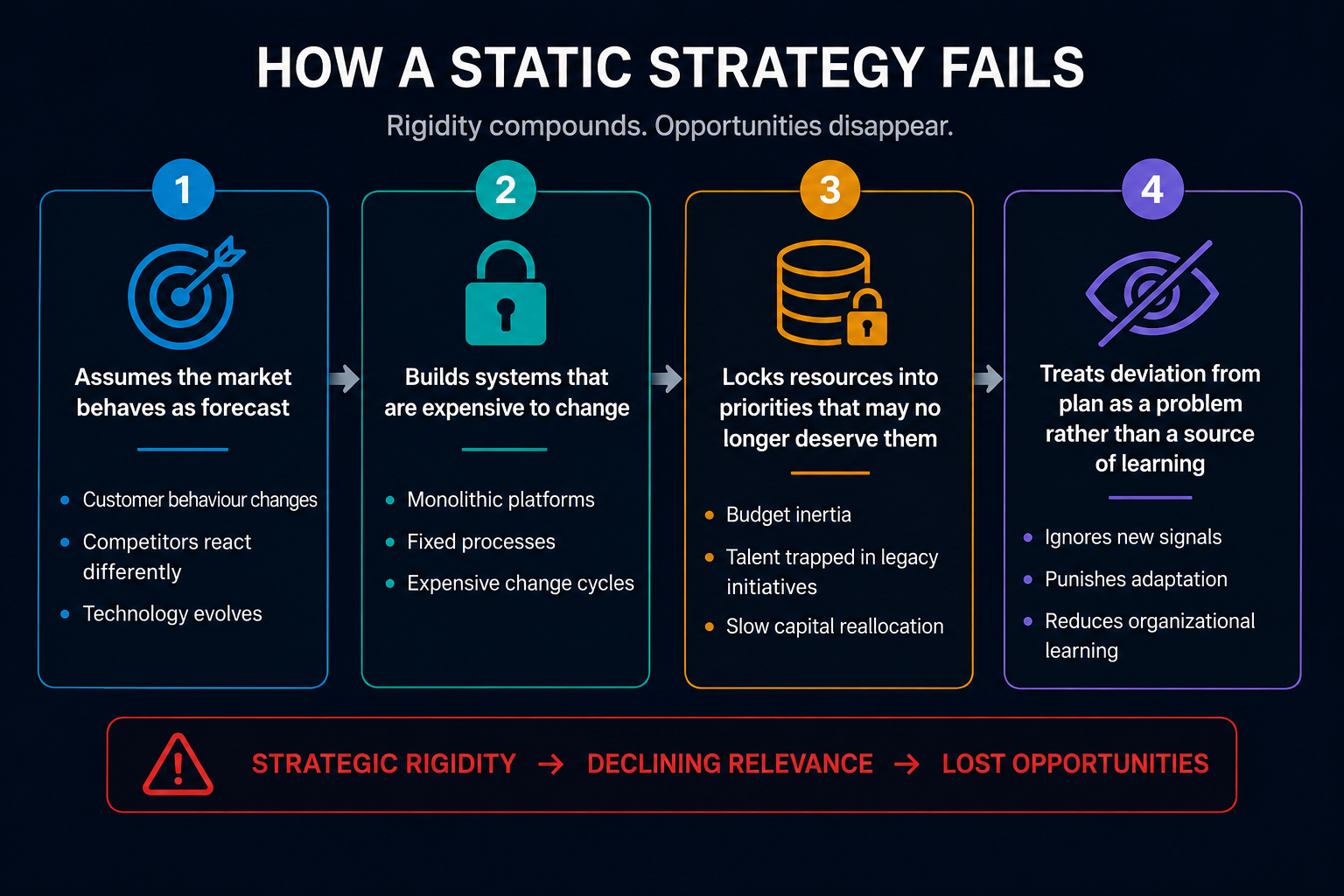
Adaptive strategy reverses assumption. It accepts that forecasts are temporary. it designs systems to be changeable. It moves resources as evidence changes. It treats deviations as signals to be interpreted. The difference is not merely cultural; it is structural.
Adaptive Strategy as a Capability System
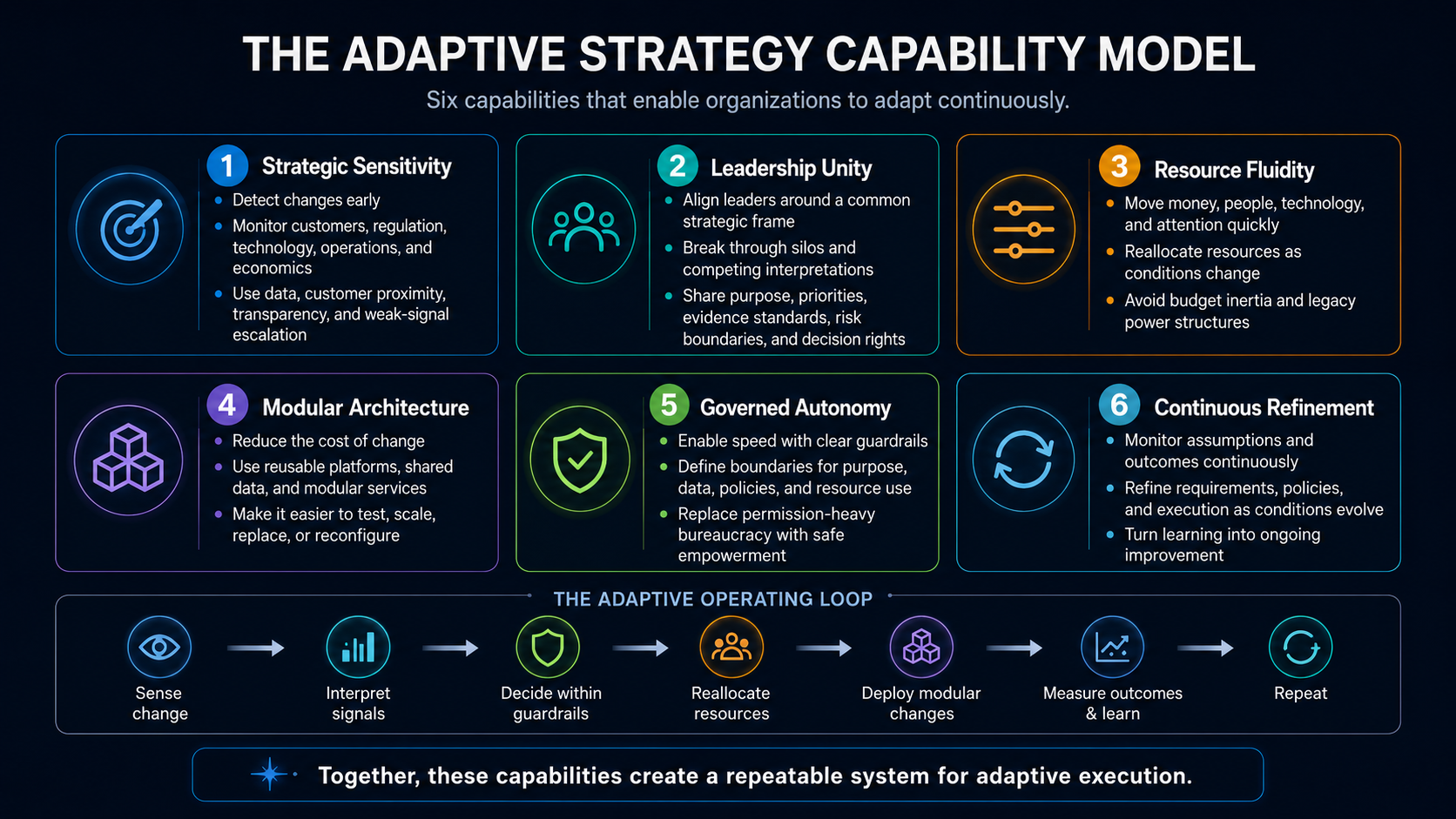
Adaptive strategy is best understood as a capability system built around a repeatable loop: sensing, interpretation, decision, resource reallocation, execution, and learning. This loop is not a software development cycle alone. It is a strategic management discipline.
Strategic Sensitivity:
The first capaility is strategic sensitivity. Organizations must detect changes in customers, regulation, technology, operations, and economics before those changes become crises. Doz and Kosonen describe strategic sensitivity as the ability to perceive and interpret signals from the environment (Doz and Kosonen, 2010). In practical terms, this requires data, customer proximity, operational transparency, and mechanisms for escalating weak signals. A retailer may sense change through app scans, delivery demand, or daypart traffic. A hospital system may sense change through occupancy, patient flow, telehealth usage, and clinical safety signals. A bank may sense change through deposit behavior, digital adoption, credit conditions, and customer acquisition economics.
Leadership Unity
The second capability is leadership unity. Adaptation often fails not because the organization lacks information, but because leaders interpret the information through competing silos. In a static organization, each function defends its plan. In an adaptive organization, leaders share a common strategic frame and can make decisions that cut across functional boundaries. Leadership unity does not require agreement on every detail. It requires agreement on purpose, priorities, eevidence standards, risk boundaries, and decision rights.
Resource Fluidity
The third capability is resource fluidity. Strategy only becomes adaptive when money, people, technology, and management attention can move. McKinsey's research on resource allocation suggests that companies that reallocate resources more dynamically are moe likely to outperform those that spread capital according to historical patterns (McKinsey & Company, 2016). This is one of the hardest disciplines for established organizations because budgets often reflect past structures. A company can sense change accurately and still fail if it cannot redirect resources quickly enough.
Modular Architecture
The fourth capability is modular architecture. Adaptive strategy depends on the cost of change. If changing a product, policy, process, or customer journey requires rewriting a large monolithic system, then strategic flexibility will be slow and expensive. MIT CISR has argued that digitized platform maturity is a critical enabler of business agility because reusable platforms, shared data, and modular services reduce the effort required to adapt (MIT CISR, 2015). This is why architecture is not merely a technology concern. It is a strategic concern. The more modular the operating model, the easier it is to test, scale, replace, or reconfigure.
Governed Autonomy
The fifth capability is governed autonomy. Adaptation requires speed, but spee without governance creates risk. This is especially true in regulated industries, healthcare, financial services, AI-enabled operations, and public-facing digital systems. MIT CISR's work on decision-rights guardrails shows that large organizations can empower teams when there are clear boundaries around purpose, data, policies, and resource allocation (van der Meulen, 2020). The goal is not to eliminate control. The goal is to replace permission-heavy bureaucracy with clear rules that allow teams to move safely.
Continuous Refinement
The sixth capability is continuous refinement. Adaptive strategy is not completed when a new initiative launches. It requires ongoing evaluation. Requirements, policies, customer needs, and risk conditions evolve. The organization must therefore monitor whether its assumptions remain valid and refine execution accordingly. This is where adaptive strategy connects directly to quality management and governance: poor signals produce poor adaptation, while weak governance allows adaptation to become inconsistent or unsafe.
Adaptive Strategy Capability Model:
Together, these capabilities form an Adaptive Strategy Capability Model. The organization senses, change, interprets signals, makes decisions within guardrails, allocates resources, deploys modular changes, measures outcomes, and learns. The loop then repeats.
Static Versus Adaptive Strategy: Three Practical Examples
The difference between static and adaptive strategy becomes clearer when translated into operating examples.
Example One: Retail Strategy
A static retail strategy assumes that the store format is the business model. It defines growth mainly as opening more locations, standardizing the offer, and driving traffic to physical sites. This model works while customer routines are stable. It becomes brittle when customers shift toward delivery, mobile ordering, evening consumption, loyalty apps, or hybrid shopping.
An adaptive retail strategy separates the underlying intent from the channel. The intent may be to become the customer's preferred food-to-go provider. The execution may includes stores, delivery partners, mobile ordering, click-and-collect, evening trading, digital loyalty, supply-chain automation, and data-driven product development. The adaptive retailer does not abandon physical stores. It turns stores into nodes with a broader customer-access system.
Greggs illustrates this distinction. The company's strategic shift was not merely to open more shops, but to extend its operating model across dayparts and channels. Its strategy included digital engagement, delivery, click-and-collect, CRM, supply-chain investment, and estate growth (Greggs, 2024a; Greggs, 2024b; Greggs, 2025a). The result is a strategy that can respond when customer behavior changes, rather than a strategy dependent on one format.
Example Two: Software Growth Stategy
A static software strategy often equates success with expansion: more markets, more acquisitions, more products, more features, and more sales coverage. This can create the appearance of growth while weakening focus, integration, and unit economics. When capital markets reward growth at any cost, such a strategy may appear successful. When profitability becomes more important, it can become exposed.
An adaptive software strategy treats growth as a portfolio of choices. It asks where the company has the strongest right to win, which customers produce the best economics, which products deserve investment, and which activities should be simplified or discontinued. Adaptation here may mean narrowing rather than expanding. It may mean reallocating capital away from broad acquisition logic and toward product-market focus, ARPU growth, and profitability.
Lightspeed Commerce demonstrates this pattern. The company shifted from broad expansion posture toward a more focused profitablt-growth strategy, including cost reductions, product concentration, improved payment economics, and attention to flagship markets (Lightspeed Commerce, 2024a; Lightspeed Commerce, 2024b; Lightspeed Commerce, 2025a). This is an important lesson: adaptive strategy is not always moving faster. Sometimes it is about becoming more selective.
Example Three:Industrial Portfolio Strategy
A static industrial strategy often centralizes control to maintain consistency. Headquarters defines priorities, operating units execute, and local variation is limited. This may create efficiency, but it can also suppress responsiveness in niche markets wehre customer needs, regulation, and technology differ.
An adaptive industrial strategy combines decentralized market responsiveness with centralized capital discipline. Local operating companies remain close to customers and technologies. Group leadership allocates capital, evaluates acquisitions, maintains governance, and ensure that returns remain strong. This model avoids the false choice between autonomy and control.
Halma is a strong example. Its operating model is built around decentralized companies, sector-level governance, and group-level capital allocation. The company's long record of profit growth, high return on capital, R&D investment, and acquisition discipline suggests that adaptive strategy can be institutionalized as a portfolio management system rather than a temporary transformation programme (Halma, 2025a; Halma, 2025b).
Cross-Case Evidence: How Adaptive Strategy Works in Practice
The six case companies examined in this paper are intentionally more managerially relatable that the cliche of Amazon, Apple, or Microsoft. They are not small companies, but they operate in sectors that many executives can understand: banking, retail, healthcare, industrial technology, logistics, and merchant software. The purpose is not to claim that each case proves causality in isolation. Public reporting rarely reveals every internal decision rule. The purpose is to identify repeated patterns in how adaptive strategy is designed and supported.
EQB: Adaptive Banking Through Digital Architecture and Partnership
EQB provides a Canadian example of adaptive strategy in financial services. The bank's shift is visible in its move from a more specialized lending and banking model toward a cloud-enabled challenger-bank model. Rather than imitating the branch-heavy structure of incumbent banks, EQB developed a digital platform, expanded EQ Bank, diversified funding, and used partnerships to extend its reach (EQB, 2024a; EQB, 2024b; EQB, 2025a).
The static alternative would have been to compete through traditional banking infrastructure: branches, conventional deposit acquisition, and incremental product expansion. EQB's adaptive model is different. It uses a cloud-based core, digital customer acquisition, product innovation, and partnership-enabled reach. These mechanisms allow the bank to sense customer demand, launch new offerings, and scale without inheriting the full cost structure of legacy banking.
The adaptation triggers are visible in customer growth, deposit behavior, product adoption, and changing expectations for digital banking. EQ Bank customer growth rose significantly from 2016 to 2024, and the bank reported continued expansion in accounts, deposits, and earnings momentum in subsequent disclosures (EQB, 2024a; EQB, 2024c; EQB, 2025a). The strategic lesson is that regulated financial institutions can become more adaptive when technology architecture, funding discipline, and risk governance are designed together. Adaptation does not mean weakening control. In banking, adaptation must be governed by risk appetite, capital adequacy, liquidity, and regulatory discipline.
Greggs: Adaptive Retail Through Channel, Daypart, and Supply-Chain Flexibility
Greggs provides one of the clearest examples of a traditional consumer business moving toward adaptigve capability. Historically, the company could have remained a high-street bakery chain. The static model would have emphasized store openings, product consistency, and daytime footfall. Instead, Greggs articulated a broader strategy to grow the estate, extend evening trade, build digital channels, and deepen customer engagement (Greggs, 2024a; Greggs, 2024b).
The mechanisms are practical and transferable. Greggs invested in delivery partnerships, click-and-collect, app-based engagement, CRM, supply-chain capacity, EPOS upgrades, and ERP capabilities. These are not isolated technology projects. They are the infrastructure that allows the company to know when and how to adapt. App scans reveal customer behavior. Delivery sales reveal channel demand. Evening trade reveals daypart opportunity. Supply-chain capacity determines whether growth can be executed without operational breakdown.
The outcomes suggest that the adaptive approach strengthened performance. Greggs reported sales above £2 billion for 2024, continued footprint growth, rising app engagement, and increased delivery participation in company-managed shop sales (Greggs, 2024a; Greggs, 2025a). The managerial insight is that adaptive retail strategy is not just digital marketing. It is the redesign of the retail business as a flexible access system supported by data, capacity, and customer feedback.
Halma: Adaptive Industrial Growth Through Decentralized Governance
Halma is a case of embedded adaptive strategy rather than a sudden pivot. The group operates through a decentralized model of specialist companies serving safety, environmental, and healthcare-related markets. Its structure allows operating companies to remain close to customers while the group provides capital allocation, governance, M&A discipline, and shared strategic direction (Halma, 2025a).
The static alternative would be a centralized industrial conglomerate with uniform decision-making and slow local response. Halma's model is more fluid. Company-level boards retain responsibility for local strategy. Sector structures provide coordination. Group leadership sets financial discipline, acquisition criteria, and long-term strategic focus. This creates a form of adaptive governance: local autonomy with enterprise guardrails.
The signals that drive adaptation include niche market growth, technology opportunities, acquisition availability, R&D needs, and return on invested capital. Halma's FY2025 results showed continued revenue growth, profit growth, strong cash conversion, R&D investment, acquisitions, and return on capital discipline (Halma, 2025a; Halma, 2025b). The lesson is that adaptive strategy can be built into organizational design. It does not require every decision to be centralized, nor does it require uncontrolled autonomy. It requires a governance system that knows which decisions belong close to the market and which decisions belong at group level.
Apollo Hospitals Enterprise:Adaptive Healthcare Through Integrated Digital and Clinical Systems
Apollo Hospitals Enterprise illustrates adaptive strategy in a complex and high-stakes environment. The static healthcare model is hospital-centric: patients arrive when they are ill, value is concentrated in inpatient care, and digital tools remain peripheral. Appolo's evolving strategy is broader. It combines hospitals, diagnostics, pharmacies, telehealth, digital access, out-of-hospital services, and patient engagement through Apollo 24/7 (Apollo Hospitals, 2024a; Apollo Hospitals, 2025a).
The adaptive mechanisms include a digital health platform, teleconsultation, pharmacy networks, diagnostics, AI-enabled tools, and clinical quality systems. Particularly important is the combination of digital access and governance. In healthcare, adaptation cannot be judged only be convenience or growth. It must be judged by safety, clinical quality, escalation, and accountability. Apollo's use of tiered clinical huddles and quality frameworks suggests that adaptation is supported by structured sensing and escalation mechanisms, not just digital front-end expansion (Apollo Hospitals, 2025a).
The outcomes include higher occupancy, increased inpatient discharges, improved revenue metrics, digital platform scale, and stronger profit performance in reported periods (Apollo Hospitals, 2025a). The broader lesson is that adaptive strategy in healthcare is not merely about creating an app. It is about redesigning care pathways so that patients can be served across multiple settings, while quality and governance remain embedded.
TFI International:Adaptive Logistics Through Portfolio Mobility and Cash Discipline
TFI International demonstrates adaptive strategy in an asset-heavy and cyclical sector. Logistics markets are exposed to freight cycles, customer demand shifts, fuel costs, labour conditions, acquisity opportunities, and regional variation. A static logistics strategy would optimize a fixed network and defend existing operating units. TFI's model is more adaptive: decentralized subsididaries, segment-level performance tracking, acquisition-led portfolio development, and disciplined cash generation (TFI International, 2025a; TFI International, 2026a).
The company's adaptive mechanism are not mainly expressed through digital language. They are expressed through organizational and financial design. Subsidiaries operate under their own brands, preserving local commercial responsiveness. Group leadership evaluations capital allocation, acquisitions, cash flow, and segment returns. The acquisition of Daseke expanded specialized truckload capability, showing how portfolio moves can adjust strategic exposure (TFI International, 2025a).
The outcomes reported for 2024 included revenue growth, adjusted EBITDA growth, strong operating cash flow, and continued acquisition-driven portfolio expansion (TFI International, 2025a). The lesson is that adaptive strategy does not always look like agile software delivery. In logistics, it may look like disciplined decentralization, acquisition optionality, cash conversion, and segment-level resource movement.
Lightspeed Commerce: Adaptive Software Strategy Through Focus and Economic Discipline
Lightspeed Commerce provides a valuable case because it shows that adoption can mean narrowing the strategy. The company had pursued expansion across products, geographies, and acquired capabilities. As profitability pressure increased, the more adaptive move was to simplify, focus, reduce costs, and concentrate investment where the company saw stronger product-market fit (Lightspeed Commerce, 2024a; Lightspeed Commerce, 2025a).
The mechanisms included restructuring, cost reductions, product focus, flagship market emphasis, payments penetration, ARPU improvement, and a stronger link between growth and adjusted EBITDA. This is adaptation through capital discipline. The company did not abandon merchant commerce; it refined the strategy pathway.
The outcome included positive adjusted EBITDA, revenue growth, improved gross payment volume, higher ARPU, and stronger profitability measures in reported results (Lightspeed Commerce, 2024b; Lightspeed Commerce, 2025a). The lesson is particularly important for start-ups and scale-ups: adaptive strategy is not equivalent to chasing every opportunity. A company adapts well when it learns where it has advantage and reallocates away from distraction.
The Key Supporting Components of Adaptive Strategy
The six cases reveal a common set of supporting components. These components are not optional accessories. They are the infrastructure of adaptive strategy.
Clear Directional Intent
The first component is clear directional intent. Adaptive strategy requires a stable purpose. Without that, adaptation becomes random movement. Greggs retained a clear food-to-go ambition while changing channels and dayparts. Lightspeed retained a merchant-commerce focus while narrowing its execution path. Halma retained its long-term focus on life-saving technologies while allowing operating companies to adapt locally.
Sensing Infrastructure
The second component is sensing infrastructure. Organizations must know when assumptions are changing. Sensing may come from customer data, operational metrics, regulatory monitoring, clinical escalation, channel performance, deposit flows, or financial returns. The essential point is that sensing must be embedded in operations, not reserved for annual strategy reviews.
Modular Digital and Operating Architecture
The third component is modular digital and operating architecture. EQB's cloud-enabled banking model, Greggs' digital and supply-chain investments, Apollo's integrated health platform, and Lightspeed's product consolidation all show that adaptability depends on the ability to change components without rewriting the entire organization. Modular architecture reduces the cost of strategic learning.
Governance Guardrails
The fourth component is governance guardrails. Adaptation must occur within boundaries. Banks require risk controls. Healthcare organizations require clinical quality. Industrial portfolios require capital discipline. Software companies require economic discipline. Retailers require brand and operational consistency. Governance should not freeze adaptation. Good governance makes adaptation scalable and trustworthy.
Resource Fluidity
The fifth component is resource fluidity. Adaptive strategy is impossible if resources remain attached to yesterday's priorities. TFI reallocates through acquisitions and segment-level financial discipline. Halma reallocates through group capital allocation and acquisition discipline. Lightspeed reallocates through cost restructuring and focused reinvestment. Resource fluidity is where strategy becomes real.
Continuous Refinement
The sixth component is continuous refinement. Adaptive organizations do not assume that one transformation will solve the problem permanently. They revise product lines, channels, digital journeys, investment priorities, and operating processes as evidence changes. Refinement is the discipline that prevents adaptation from becoming episodic.
Conclusion
Adaptive strategy is not a fashionable alternative to planning. It is the necessary evolution of strategy in environments where uncertainty, technological change, regulatory movement, and customer expectations make fixed-path execution increasingly fragile or brittle. Traditional strategy assumed that the organization could analyze the environment, choose a position, allocate resources, and execute the plan. Adaptive strategy assumes that the organization must keep learning while it executes.
The core distinction is simple but profound. Static strategy commits to assumptions. Adaptive strategy commits to purpose, capability, and disciplined change. Static strategy asks the organization to defend a plan. Adaptive strategy asks the organization to sense, decide, reallocate, execute, and refine.
The evidence from EQB, Greggs, Halma, Apollo Hospitals, TFI International, and Lightspeed Commerce shows that adaptive strategy is not confined to syperscale technology firms. It can be embedded in banking, retail, industrial technology, healthcare, logistics, and software. The mechanisms differ by sector, but the underlying patter is consistent. Adaptive organizations build sensing systems, modular platforms, governed autonomy, capital discipline, and refinement loops.
The most important conclusion is that adaptability must be designed. It cannot depend on heroic leadership or periodic transformation projects. It must be built into architecture, governance, decision rights, resource allocation, and operating rhythms. Organizations that do this well are not merely faster. They are more coherent under uncertainty. They can change direction without losing purpose. They can experiment without losing control. They can refine execution without rewriting strategy from scratch.
The winning organization is not the one that predicts the future perfectly. It is the one that knows how to change when the future refuses to match the forecast.
Requirementum QGR and the New Model of Capability Development
The conclusion of this paper argues that adaptive strategy becomes valuable only when organizations can translate change into action without losing discipline, clarity, or control. Requirementum applies that same principle to digital capability development.
For decades, organizations have relied on large teams, long timelines, and fragmented handoffs to create digital solutions. Traditional SDLC models often move too slowly when business conditions change, while Agile methods can improve iteration without always solving the deeper problems of unclear requirements, weak analysis, and disconnected governance.
Requirementum reframes this model by bringing business expertise, architecture, senior analysis, and AI-enabled delivery closer together. Through Intentium™, its expert-led software delivery model, Requirementum helps organizations move from business intent to digital capability with greater clarity, speed and accountability.
The strategic difference is that Requirementum does not treat requirements as static documents for delivery inputs. It treats them as living instruments of capability development. Senior Analysts and domain experts clarify intent, validate assumpitions, define requirements, guide AI-enabled development, and ensure that governance remains connected to delivery.
This directly supports adaptive strategy. If organizations must sense change, interpret signals, and refine execution, then they also need a development model capable of changing with them. Requirementum helps close that gap by reducing ambiguitiy, shortening handoffs, and turning expert knowlege into governed digital capability.
In this sense, Requirementum provides the practical bridge between adaptive strategy and execution. It helps organizations build digital capabilities that are not only delivered faster, but designed to evolve as markets, regulations, technologies, and customer expectations change.
.png)