.svg)
Consulting contracts do more than define how a supplier gets paid. They shape behavior. A staff augmentation contract rewards availability, continuity, and utilization. A fixed-scope or fixed-deliverable contract rewards clarity, efficiency, and margin protection. Neither model is inherently good or bad. Each can create value when matched to the right level of uncertainty, governance maturity, delivery urgency, and business objective. Each can also produce poor outcomes when the commercial model quietly works against the client’s real goal.

The central issue is not whether an organization should use staff augmentation or fixed-price consulting. The better question is: what behavior will this contract model encourage once the project becomes difficult? Open-ended hourly models can quietly reward duration, resource expansion, and scope drift. Fixed contracts can quietly reward narrow interpretation, defensive change control, and quality compression. The optimal commercial structure aligns supplier incentives with client outcomes, while preserving enough flexibility to respond to legitimate learning.
For Requirementum QGR, the strongest position is clear: clients do not always need more consulting capacity; they often need bounded clarity, decision support, and implementation readiness. Fixed package contracts, when properly structured, can give clients defined outcomes, practical deliverables, transparent assumptions, and controlled commercial exposure without creating dependency on open-ended hourly consulting.
The Contract Model Is a Behavioral Design
A consulting contract is usually treated as a procurement document. That is too narrow. In practice, it is also a behavioral system. It defines who carries uncertainty, who benefits from speed, who absorbs inefficiency, who controls scope, and who decides whether the work is complete.
This is why public-sector procurement guidance in multiple jurisdictions increasingly emphasizes value for money, risk allocation, transparency, and contract management rather than price alone. The UK Government’s risk allocation guidance states that inappropriate or disproportionate risk allocation is widely recognized as a reason contracts underperform or fail (Cabinet Office, 2026). The OECD similarly frames procurement risk as something that must be identified, assessed, treated, and monitored throughout the process, especially for complex goods, services, and infrastructure (OECD, 2023).
This matters because consulting work often operates in uncertainty. Transformation programs, ERP selection, AI readiness, business architecture, requirements discovery, and operating model design rarely begin with perfect information. The contract model determines how both parties behave when information improves.
A staff augmentation model says: “Provide skilled people for as long as we need them.” A fixed-deliverable model says: “Produce a defined result under agreed assumptions.” A managed service model says: “Operate this function to agreed service levels.” An outcome-based model says: “Deliver a measurable business result.” Each model is suitable in some circumstances and dangerous in others.
The mistake is assuming that a contract type is merely an administrative choice. It is not. It is a management decision that influences cost, speed, quality, accountability, and trust.
Key Concepts and Contract Types
Before comparing the models, it is useful to define the terms.
Term
Meaning
Staff Augmentation
The client brings in external individuals to supplement internal capacity. The client usually directs day-to-day work. Payment is commonly hourly or daily.
Time and materials
The supplier bills for labour time, and, where relevant, materials or expenses. In the US Federal Acquisition Regulation, time-and-materials contracts are based on direct labour hours at specified rates plus actual material costs (FAR, 2024).
Open-ended hourly contracting
A flexible time-based arrangement with limited or evolving scope, often extended through renewals or task authorizations.
Managed Services
The supplier manages an ongoing function or service against agreed service levels, often with operational accountability transferred to the supplier.
Fixed-price contract
A contract where the supplier agrees to perform work for a set price. In a firm-fixed-price structure, the contractor carries maximum cost risk and profit/loss responsiblity (FAR 2024)
Fixed-scope contract
A contract where the boundaries of work are defined in advance. The focus is what is included and excluded.
Fixed-deliverable contract
A contract structured around defined outputs, such as a roadmap, business case, assessment, requirements package, RFP, or architecture model.
Outcome-based contract
A contract where success is tied to measurable business results, not merely tasks or artefacts.
Milestone-based contract
A contract where payment or acceptance is tied to completion of stages, phases, or deliverables.
Discovery / diagnostic engagement
A bounded phase designed to reduce uncertainty, clarify scope, assess readiness, and support decision-making.
Change request
A formal mechanism to alter scope, price, timeline, or obligations after the contract is agreed.
Scope control
The governance discipline of determining what work is included, what is excluded, and how changes are assessed.
Commercial risk transfer
The extent to which financial or delivery risk shifts from client to supplier
Requirements certainty
The degree to which business needs, constraints, stakeholders, dependencies, and acceptance criteria are understood.
Delivery accountability
The extent to which the supplier is responsible for achieving agreed outputs or outcomes, rather than merely supplying effort.
Prix Fixe
A fixed menu offered to time and material contractors in a fine dining establishment.
These definitions matter because many failed consulting engagements begin with language confusion. A client may think it is buying outcomes when the supplier is only selling capacity. A supplier may think it is selling a fixed deliverable when the client expects adaptive consulting. Misalignment begins early and becomes expensive later.
Why Organizations Use Staff Augmentation
Staff augmentation remains popular because it solves an immediate managerial problem: The organization needs more people now.
This is common in digital transformation, ERP replacement, data migration, compliance remediation, AI experimentation, backlog delivery, business analysis, testing, architecture support, and project management. Hiring permanent staff can be slow. Internal teams may lack specialized skills. Procurement may already have an approved staffing vendor or task-based vehicle. Business sponsors may not yet know enough to define a fixed scope.
In Canada, federal task-based professional services are described as services with a specific start date, end date, and set of deliverables, often used for one-time or short-term work (Public Services and Procurement Canada, 2026). Yet in practice, task-based and time-based professional services can become ongoing capacity mechanisms when organizations repeatedly extend resources or issue new tasks. Staff augmentation works well when the client has strong internal leadership. It is especially useful when:
For example, a retailer implementing a known set of checkout messaging changes may need a business analyst, QA analyst, or integration specialist for a short period. If the client controls the backlog, owns the architecture, and can measure weekly progress, staff augmentation can be efficient and pragmatic.
The model becomes risky when “temporary capacity” becomes a substitute for strategy, architecture, prioritization, or accountability.
The Risks of Open-Ended Hourly Staff Augmentation
The main risk of open-ended hourly consulting is that the client pays for effort rather than results. This does not mean the consultants are poor or unethical. It means the contract model does not naturally reward completion.
The US FAR is unusually direct about this issue. It states that a time-and-materials contract provides no positive profit incentive for cost control or labour efficiency and therefore requires appropriate government surveillance of contractor performance (FAR, 2024). That sentence captures the commercial problem perfectly: if the supplier earns more when more hours are used, the client must actively manage value.
Common risks include:
Scope drift. Work expands gradually because there is no hard commercial forcing function to define “done.”
Embedded dependency. Consultants become part of the furniture. They understand the systems, meetings, politics, and decision history, but that knowledge may remain tacit.
Ambiguous accountability. If a project fails, the client may blame the consultants, but the consultants may argue they were only directed resources.
Weak exit criteria. Extensions become easier than transition planning.
Burn-rate normalization. A monthly consulting cost that once required justification becomes part of the project baseline.
Consultant utilization over client value. A consulting company’s internal economics often emphasize billable utilization, leverage, and account growth. Those are legitimate business goals, but they are not automatically the same as the client’s desired outcome.
Low visibility into productivity. A client may know that five consultants billed 800 hours, but not whether those hours produced decision-quality analysis, reduced uncertainty, improved delivery readiness, or transferred capability.
The project-management literature also supports the importance of requirements discipline. PMI has reported that requirements issues are associated with scope creep, poor communication, lack of stakeholder involvement, and inadequate sponsor support, and that 47% of unsuccessful projects fail to meet goals due to inaccurate requirements management (PMI, 2014). In open-ended models, requirements weakness can quietly generate more hours rather than trigger a structured reset.
Revenue-Maximizing Behaviours in Open-Ended Models
Professional services firms are businesses. Their commercial incentives matter. A mature client should understand these incentives without assuming bad faith.
In an open-ended hourly model, revenue can increase through:
Some of this can be legitimate. A transformation program may genuinely require more specialists as complexity emerges. The problem arises when expansion is not tied to business value, decision gates, or measurable outcomes.
The warning sign is not that a supplier recommends more work. The warning sign is that the recommendation lacks a clear link to value, risk reduction, or a defined decision.
A client should ask: "What decision will this additional effort enable?" "What risk will it reduce?" "What deliverable will exist when it is complete?" " What internal capability will remain after the consultant leaves?"
Why Organizations Use Fixed-Scope or Fixed-Deliverable Contracts
Fixed-scope and fixed-deliverable contracts appeal to executives because they promise clarity. A defined price, scope, timeline, and deliverable package is easier to approve than an uncertain burn rate.
This model is especially suitable when the client needs a specific artefact or decision-ready outcome:
These are not necessarily implementation contracts. Many are advisory contracts designed to reduce uncertainty before a larger investment decision.
Fixed contracts also align with broader public procurement principles. Australia’s Commonwealth Procurement Rules state that value for money is the core rule and that price is not the sole factor; officials must consider quality, fitness for purpose, supplier experience, flexibility, and whole-of-life costs (Department of Finance, 2026). The EU’s public procurement framework similarly emphasizes the “most economically advantageous tender,” considering value for money, quality, life-cycle costs, environmental and social factors, and innovation rather than lowest price alone (European Parliament, 2026).
A good fixed-deliverable contract is not simply a cheap fixed-price deal. It is a structured agreement to produce useful outputs under defined assumptions. It should create clarity, not rigidity.
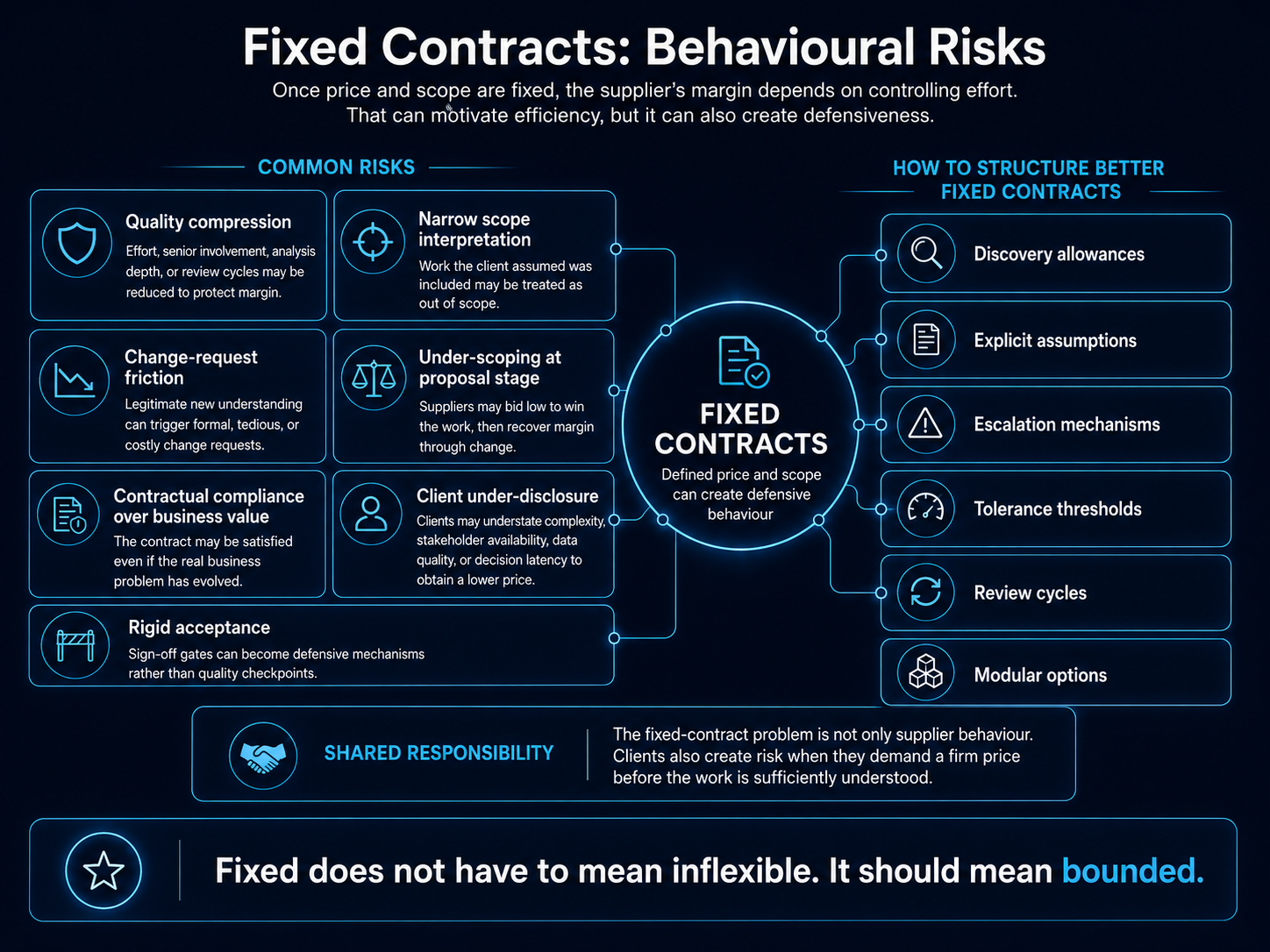
Revenue-Maximizing Behaviours in Fixed Contracts
In fixed-scope consulting, revenue expansion usually occurs differently than in open-ended hourly models. The supplier is less likely to simply add hours. Instead, revenue may increase through scope interpretation and change control.
Common Revenue-Maximizing Behaviors Include:
Again, not every change request is bad. A disciplined change request can protect both parties. The issue is whether change control supports better decisions or becomes a revenue mechanism.
A healthy fixed-contract change process distinguishes between:
Dimension
Staff Augmentation / Open-ended hourly model
Fixed-scope / fixed-deliverable model
Primary client risk
Primary supplier incentive
Best Mitigation
Cost control
Variable; cost grows with time and resources
Predictable if scope holds
Uncontrolled burn rate or repeated extensions
Maximize utilization or duration
Burn-rate dashboards, monthly value reviews, exit criteria
Scope Control
Flexible but vulnerable to drift
Controlled but vulnerable to rigidity
Work expands without defined outcome
Interpret scope broadly in T&M; narrowly in fixed
Scope register, decision log, tolerance thresholds
Quality
Depends on consultant skill and client oversight
Depends on acceptance criteria and review cycles
Effort without outcome, or deliverable without depth
Keep people billing, or protect margin
Quality standards, peer review, senior oversight
Speed
Fast to start
Slower to define but faster to govern
Rapid start without direction
Deploy resources quickly
Time-boxed onboarding and weekly outputs
Flexibility
High
Moderate if modular
Flexibility becomes ambiguity
Continue billing while scope evolves
Backlog governance and phase gates
Accountability
Often shared or ambiguous
Clearer if deliverables are defined
"We provided the resource" defence
Avoid ownership of outcomes
RACI, deliverable ownership, acceptance criteria
Knowledge Transfer
Often weak unless required
Stronger if artefacts are required
Dependency on individuals
Keep expertise embedded
Knowledge-transfer plan and reusable artefacts
Governance Effort
High for client
High at start, lower during execution
Client must supervise work continuously
Client absorbs management effort
Governance cadence and reporting templates
Change Management
Informal unless controlled
Formal and sometimes adversarial
Scope creep or change-request fatigue
Expand hours or monetize change
Change categories and thresholds
Best Use
Temporary capacity, backlog support, uncertain tasks
Defined outputs, assessments, roadmaps, requirements packages
Wrong model selected for the work
Commercial model drives behavior
Contract model selection assessment
Risk Allocation
More risk retained by client
More delivery risk transferred to supplier
Client owns inefficiency
Supplier protects margin
Shared risk register and decision gates
The comparison shows that the two models do not simply differ in price structure. They differ in how they allocate uncertainty.
Open-ended staff augmentation is more tolerant of uncertainty, but it can reward delay. Fixed-scope consulting is better for cost and deliverable certainty, but it can punish legitimate learning unless structured carefully.
Warning Signs in Staff Augmentation
Staff augmentation is becoming unhealthy when:
The strongest warning sign is dependency. If the consultant’s presence becomes necessary because no one else understands the work, the engagement has shifted from augmentation to institutional memory outsourcing.
How to Structure Staff Augmentation Well

When Fixed-Scope Consulting is the Right Model
Fixed-scope or fixed-deliverable consulting is the right model when the client needs expertise, structure, and decision-ready outputs. It works best when:
For example, in an ERP implementation, staff augmentation may be appropriate for a business analyst supporting data migration workshops, test-case preparation, user-story refinement, or training documentation. The client already has the ERP program structure, implementation partner, governance model, and target scope. The augmented consultant provides capacity within that machine.
In AI readiness work, staff augmentation may make sense when an organization already has an AI governance framework and needs temporary support cataloguing use cases or documenting policies. It is less suitable when the organization does not yet know what AI readiness means, where risks exist, or what executive decisions are required.
The rule is simple: use staff augmentation when the client can direct the work effectively. Do not use it when the client needs the supplier to define the work.
When Staff Augmentation Is the Right Model
Staff augmentation is the right model when the client wants control more than transfer of accountability.
It works best when:
For example, an ERP selection readiness package can be fixed effectively. It may include stakeholder workshops, current-state process review, capability mapping, high-level requirements, RFI / RFP criteria, vendor demonstration scenarios, risk assessment, and executive recommendation. The client is not buying endless business analysis. It is buying a decision platform.
Similarly, a business architecture package can be fixed when the deliverables are clear: capability model, value stream analysis, process inventory, system context, pain-point analysis, investment themes, and transformation roadmap.
A requirements discovery package can also be fixed if it is designed as a bounded diagnostic rather than a promise to discover every possible requirement. The output might be an implementation-ready requirements baseline, backlog structure, risk register, assumptions log, and decision list.
This is where Requirementum QGR can credibly differentiate.
The Best Model: A Hybrid Commercial Structure
The best consulting model is often hybrid.
A strong hybrid structure looks like:

This model preserves flexibility without rewarding drift. It provides certainty without punishing legitimate learning. It also creates natural decision gates: continue, pause, change direction, or expand.
The UK’s 2026 Contract Management Playbook emphasizes better delivery outcomes through established contract management principles and best practices (Cabinet Office, 2026). That principle is directly applicable outside government: the commercial structure should make the desired behaviour easier, not harder.
For complex consulting work, the hybrid model is often superior because it recognizes that uncertainty should be reduced before it is priced heavily. It also recognizes that not all uncertainty should become hourly drift.
Practical Examples
Digital Transformation - A company launching a customer self-service portal may be tempted to hire multiple contractors for business analysis, UX, QA, and project coordination. Staff augmentation may help if a strong product team already exists. But if the organization has not defined the target customer journeys, system context, data dependencies, privacy constraints, or success measures, adding people will accelerate confusion.
A fixed discovery package should come first. It can define the business capabilities affected, current-state friction, future-state journeys, high-level requirements, risks, and roadmap. Staff augmentation can then support delivery after direction is clear.
ERP Selection - An ERP selection is rarely just software procurement. It involves finance, operations, reporting, controls, data migration, integration, governance, and change management. A time-based advisory model can expand rapidly because every department has legitimate needs.
A fixed ERP selection readiness package can provide bounded value: capability map, process inventory, requirements catalogue, vendor scoring model, demonstration scenarios, RFI/RFP structure, and implementation risk assessment.
Business Architecture - Business architecture is often misunderstood. If delivered hourly without clear outputs, it can become abstract modelling. If delivered as a fixed package, it can produce concrete decision artefacts: capability model, value streams, process hierarchy, information flows, system context, initiative map, and investment priorities.
AI Readiness - AI readiness is currently a high-risk consulting category because demand is high and definitions vary. BCG reported in 2024 that only 26% of companies had developed the capabilities needed to move beyond AI proofs of concept and generate tangible value (BCG, 2024). This is exactly where open-ended consulting can expand: more pilots, more workshops, more tools, more uncertainty.
A fixed AI readiness package should focus on practical questions: use-case suitability, data readiness, governance, privacy, security, human oversight, operating model impact, vendor risk, and implementation roadmap.
Requirements Discovery - Requirements discovery is ideal for a fixed package if positioned correctly. The promise should not be “all requirements forever.” The promise should be “a structured, validated, decision-ready requirements baseline sufficient to support planning, procurement, estimation, or implementation.”
That distinction protects both client and supplier.
Practical Contract Design Checklist
Before choosing a contract model, clients should answer these questions:
Conclusion: Align the Contract With the Behaviour You Want
The wrong contract model can create the wrong behaviour even when both parties are competent and well-intentioned.
Open-ended staff augmentation can reward duration, expansion, and dependency. Fixed-scope consulting can reward narrow interpretation, defensive change control, and margin protection. The answer is not to reject either model. The answer is to use each model deliberately.
Staff augmentation is appropriate when the client has strong internal leadership, mature governance, and a genuine need for temporary capacity. Fixed-scope consulting is appropriate when the client needs defined deliverables, decision support, and budget certainty. Hybrid models are often best when discovery is needed before larger commitments are made.
The future of professional services should not be built around selling more hours. It should be built around reducing uncertainty, improving decisions, transferring knowledge, and enabling execution.
That is the strategic position for Requirementum QGR.
Requirementum QGR’s fixed package model is designed to provide clients with clear, practical, decision-ready outcomes while reducing ambiguity, controlling cost exposure, and avoiding the dependency risks of open-ended staff augmentation.
The strongest commercial promise is not “fixed price at all costs.”
It is this: bounded work, clear outcomes, transparent assumptions, practical deliverables, and no uncontrolled hourly spend.

.png)